September 25, 2010

A Great Way to Start the Day


Usually, we tend to go for pretty simple breakfasts.  My typical breakfast is a handfull of almonds and a bit of fruit or a cup of yogurt, or maybe an English muffin... or some toast, like that pictured above with some of the peach jam Juli recently made.  This morning, though, I decided to make something a little different.

The Best-Ever Recipes collection I reviewed awhile back (http://jeffreyandjulicook.blogspot.com/2010/09/best-ever-recipes-lives-up-to-its-title.html) included a recipe for multi-grain pancakes.  With granola cereal ground fine and mixed in with the flour, they sounded pretty good, so I thought I'd give them a shot.


I made the pancakes in our new electric skillet.  They cooked up wonderfully.  In the end, we had a big plate of pancakes.  They were fluffy yet substantial, and very flavorful.  We served them up with maple and apricot syrups, maple breakfast sausage and orange-pineapple juice.  That was a good breakfast to get us ready for a big day of shopping and cooking.

What's a CSA, anyway?!?

One of the reasons Jeffrey and I have been able to eat better this summer has to do with the CSA we joined this July.  What's a CSA?  It is Community Supported Agriculture.  We chose Foxfire Acres as the farm to partner with, based on searches at Local Harvest.  It had good reviews, was more generous with produce amounts than some others we looked at, and the Des Moines pickup site was right on our way home from work- very convenient.  Here's how a CSA works:  you buy a share of the farm's produce in advance of the growing season.  Then when the garden starts producing, you make weekly pickups of your food.  Foxfire is all fruits and vegetables, but other CSA's also have meat, cheese, egg, or fresh cut flower options.

Jeffrey and I decided to try a half season/ half share, because honestly, you have to come up with a what amounts to a large amount of money all in one chunk (or two chunks, if you're on a full season plan) upfront, and we weren't sure if we'd like it, or if we'd end up wasting food, or if the quantities would suit us.  It was a great experience, and we are buying a full season/ half share for next year.    Here's what our last box of the season looked like, all spread out:

There were:  
2 spaghetti squash
1 butternut squash
1 acorn squash
4 eggplant
a bunch of golden delicious apples
6 small pie pumpkins
4 small cucumbers
1 summer squash
a dozen tomatoes (mix of golden and red)
1 large yellow onion


We love CSA pickup day, it's always a wonderful surprise to see what we get!  Since we're up for new experiences, getting our box every week lets us try veggies we otherwise would ignore.  I've had more squash this summer than I've had in my whole life!  Eggplant is a vegetable I previously wasn't so fond of, but I have enjoyed the Eggplant Parmesan and other eggplant dishes Jeffrey has made.  The only real dud vegetable, in terms of our own taste preferences, was okra.  We tried it 2 or 3 different ways, and it still tastes like something only a cow would be happy to chew on.  Maybe we just haven't met the right recipe yet!

As a two-person household with our own small vegetable garden, the amount of food was just right for us.  We got to eat lots of sweet corn, tomatoes, peaches, watermelon, cantaloupe, eggplant and squash.  Having the weekly food pickup forced us to eat more fresh food than we would have otherwise purchased at the grocery store, and it certainly was healthy.  I'm prediabetic, and my blood sugar levels, checked in February and September, showed that my high blood sugar has now decreased to the high-but-normal range.  We are very pleased with Foxfire Acres!

Something New, Times Two

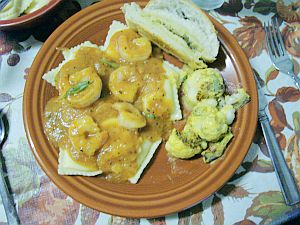
For last night's dinner I prepared cheese ravioli with Tomato Shrimp Sauce and Roasted Cauliflower with Curry-Yogurt Sauce, plus garlic bread.   This was my first time preparing both the Tomato Shrimp Sauce and the Roasted Cauliflower, though I've made a lot of recipes similar to the Tomato Shrimp Sauce. 


The shrimp sauce is in the pale yellow serving bowl at the top left of the picture, next to the garlic bread.  The cauliflower is at the bottom right.

The cauliflower recipe was originally printed in an issue of Cook's Illustrated; I got it from America's Test Kitchen's Best-Ever Recipes, which I reviewed here:  http://jeffreyandjulicook.blogspot.com/2010/09/best-ever-recipes-lives-up-to-its-title.html .

The Tomato Shrimp Sauce recipe was inspired by one I found in an old issue of Taste of Home magazine. Truth to tell, I'm not a big fan of Taste of Home.  Too many of the recipes are based on pre-prepared convenience foods such as canned soup.  While there's nothing at all wrong with a busy person cutting corners like that in order to get a meal on the table with a minimum of time and fuss, in my cooking I generally prioritize quality over speed (though I do prize recipes that balance those two factors to good result).  In any case, there are some really solid recipes in that magazine too, and I've adapted more than a few of them to my own tastes - sometimes even retaining some of the pre-packaged ingredients.  You just have to weed through a lot of bland, ho-hum recipes to find the gems.  For that reason, we don't usually buy it, but we're glad to pick up a pile of back issues when we find them at garage sales.

Anyhow, here's my recipe.

Tomato Shrimp Sauce

yield = 4 servings

1     can (14.5 oz) Italian-style stewed tomatoes
1     small to medium onion, chopped fine
2     tablespoons butter
2     teaspoons minced garlic
2     tablespoons all-purpose flour
1     tablespoon brown sugar
1     bay leaf
1/2  teaspoon dried basil
1/2  teaspoon salt
1/4  teaspoon freshly-ground black pepper
1/8  teaspoon ground cloves
1/3  cup water
1/2  pound pasta or 1 pound fresh or frozen cheese ravioli
1/2  pound medium or large shrimp, peeled and deveined
2     teaspoons fresh basil, chopped
1/4  cup grated Parmesan cheese (optional)

Puree the tomatoes in a food processor; set aside.  Start water boiling for pasta or ravioli.

Heat butter in a large skillet over medium-high heat.  Add onion and garlic; sautee until onion is tender.  Stir in flour until blended; stir and cook for about 2 minutes.

Add pureed tomatoes, stir, and cook for 1 minute.  Add brown sugar, bay leaf, basil, salt, pepper, ground cloves and water,  Stir, bring to a boil.  Reduce  heat and simmer, uncovered, for approximately 5 minutes or until well-thickened.  Meanwhile, cook pasta or ravioli according to package directions.

Remove and discard bay leaf.  Add shrimp and stir to cook until the shrimp is done.   Drain pasta.  Spoon shrimp and tomato sauce atop cooked pasta or ravioli and top with chopped fresh basil (and grated Parmesan cheese, if desired).


We cooked some frozen ravioli from the grocery store.  The garlic bread was also store-bought; we just warmed it up in the oven.

Everything turned out quite tasty.  The cauliflower was especially good.  As promised in the recipe, roasting it made it a lot more flavorful than usual for cauliflower, and the sauce - an Indian-inspired one - enhanced that flavor very nicely.  The shrimp sauce was also quite good.  We skipped the grated Parmesan cheese because the ravioli were stuffed with plenty of cheese.

September 24, 2010

Crunchy Cookie Goodness

One of our favorite blogs is Iowa Sue's "The Iowa Housewife."  You can find it at http://iowasue.blogspot.com/ .  If you haven't checked it out, do yourself a favor and do so.  Her blog is full of good stuff, including some great recipes.

Lately she's been featuring a tasty-looking bunch of cookie recipes and other sorts of desserts.  We're planning to give her Coconut Pudding recipe a try, but tonight we were in more of a cookie mood.  After looking through several good options, we settled on her Coconut Orange Slice Cookies.  We both liked the basic idea of that one, but I decided to make a couple of changes, in order to put my own spin on her recipe.

You can see her original here:  http://iowasue.blogspot.com/search/label/Cookies .

The changes I made consist of the following:
1)  Whereas the original recipe called for some cut-up Orange Slice Gumdrop Candies, we decided to go a bit more healthy.  I chopped up a half-dozen dried apricots and a tablespoon or so of dried cherries.
2)  In the original recipe, the dough was placed on the cookie sheets by the heaping-teaspoonfull.  I wanted to make slightly larger and thicker cookies, so I divided the dough into a bunch of balls about the size of a ping-pong ball, then slightly flattened them, placing 9 on a sheet in three staggered rows.  As a result, I got two dozen cookies, rather than the three dozen one gets if exactly following Iowa Sue's original recipe.
3)  Rather than oil or spray the cookie sheets, I prefer to line the sheet with parchment paper.

Other than those changes, we followed Sue's recipe exactly.  So, if someone wants to try my version, go to her blog, get the original recipe there, then make the changes outlined above.  Or, you might want to make her version as well as mine.  After all, is there ever a situation in which two batches of cookies isn't better than a single batch?

Here's the result of my tinkering with the original recipe.


We're quite pleased with these cookies.  They're nice and crunchy due to the cornflakes hand-mixed into the dough, and the chewy bits of fruit provide a nice contrast with the cookies' crispness, beyond that already provided by the coconut.  The bits of dried cherry also add a tartness that contrasts nicely with the cookies' sweetness.  I'll probably put more of those in the mix next time, but I decided to go a bit light with the cherries this time, as I didn't want to take a chance of the tartness overwhelming the other flavors. 

All in all, these are great cookies.  I guess a good name for my variant version would be Fruit and Coconut Crunch Cookies.  Still, the real credit belongs to Iowa Sue.  So, thanks for posting the the original recipe, Sue.   I'm looking forward to trying out some more of your recipes real soon.


This Book Got Me Started

Started with Indian cooking, that is.   All the recipes I made during my first three-day adventure in Indian cooking came from the same cookbook.  Following is a review of that book.

Easy Indian Cookbook: The Step-by-Step Guide to Deliciously Easy Indian Food at Home by Manju Malhi
216 pages, spiral bound   

One of the blurbs on the back cover of the book reads "Genuine Indian food made easy so you can experience and enjoy the real thing in your own home."  I'd say that description is a pretty good one.  The recipes are clearly written and pretty straight-forward in terms of technique, and none of the required ingredients are difficult to find if one has access to a good Indian or Asian grocery, or simply a wide range of spices via Penzey's or some similar source.

The book begins with a basic discussion of typically Indian ingredients and techniques, then moves on to some simple, basic recipes for making Indian breads, chutneys, spice mixes and rice.   Overall, this section of the book is pretty good, but it isn't without problems.  As I mentioned yesterday, I found the Naan recipe to be a disappointment, but the rest of these basic recipes have worked out just fine.  Also, I think the discussion of Indian ingredients and cooking techniques could have benefited a lot from some illustrations. 

After getting the basic stuff out of the way, the author moves on to the real core of the book:  A wide selection of recipes, divided up between snacks and appetizers, vegetarian, meat and poultry, seafood, side dishes and desserts.  the book ends with a discussion of what dishes one might wish to serve together for specific sorts of situations (box lunch, romantic dinner for two, cocktail party, family meal, etc.). 

I should note that I own a different printing of this book than the one pictured above.  Apparently there are several printings of the book on the market, some (like mine) softcover, others spiral-bound.   The one pictured above includes a CD of traditional Indian music.  I've not heard the music, so I can't comment on it, but I doubt it takes anything away from the quality of the recipes (which is probably what most potential buyers really care about), and I suppose it might add some nice atmosphere to one's dining experience.   The printing I bought doesn't appear to be available anywhere online (I got it the remainder/bargain section of a bookstore), but I'm pretty certain the different versions of the book are identical in terms of content (same page count, same format, etc.).  

To date, I have prepared approximately 1/4 of the recipes in this book.  There are a lot of recipes for dishes that will be familiar to anyone with even a modest knowledge of Indian cuisine.  These include standard Indian restaurant fare like Vegetable Samosas, Rogan Josh, Chicken Korma, Mattar Paneer and some versions of Biryani (meat or vegetables cooked along with rice), as well as some less typical choices, such as Tandoori-Style Trout.  Based on my experience, the recipes are of variable quality, but the vast majority of the ones I've prepared have fallen in the very-good-to-excellent range (4 to 5 stars, by the ranking Juli and I use around the house).  Some of our favorites have included an Indian Tomato Soup, Channa Masala (chickpea curry), the Bhuna Dal and Tandoori Chicken Bites (both pictured above), Shrimp with Garlic and Chili, and Pork Vindaloo.  We've revisited some of those recipes already, and there are still a lot of recipes in the book I look forward to making.

Although we haven't found this book to fall within the "every recipe is a winner" category, the hit/miss ratio is still quite good.  I've used this book a lot, and I consider it a very good choice for someone new to Indian cooking.

September 23, 2010

Our First Indian Cooking Adventure

I've written previously about how I got back into cooking in a big way fairly recently, after finding an Indian cookbook I really liked and deciding to make some of the recipes from that book.  After a couple days spent locating an Indian grocery, arriving at a menu plan and doing the necessary shopping for ingredients, our current cooking adventure officially started on Saturday, July 24 of this year.  I'd decided on several recipes I wanted to prepare for lunch and dinner on July 24 and for dinner on July 25 and 26. 

The picture above shows the first meal I prepared.  The main dishes consist of Tandoori-Style Chicken Bites (skewers of chicken marinated in a spicy yogurt sauce and grilled) and Bhuna Dal (a type of lentil soup).   The meal also featured some vegetable samosas and a tamarind chutney purchased at the Indian grocery, and a Mint and Yogurt Chutney I made (they are in the little bowls at the lower left of the picture; the Mint and Yogurt Chutney is the one that is cut off at the edge of the picture). 

All the dishes turned out great.  I'm glad, because if that first effort had turned out to be a dud, it probably would have dampened my enthusiasm, and possibly kept me from becoming reinvigorated about cooking, which in turn would have robbed me of the great time I've been having cooking lately.
 
Over the next couple days I made several other dishes, including Chicken Dhansak, Chicken Tikka Masala (using the leftover Tandoori-Style Chicken), Malabar Shrimp Curry, Aloo Gobhi (spiced, stir-fried potatoes and cauliflower), Mattar Paneer (a curry with peas and paneeer cheese), Lashuni Rai Beans (stir fried green beans), Naan and Pooris breads, an Indian Rice Pudding and Narilal Laddoo (more or less an Indian version of coconut macaroons).  Some of these turned out better than others.  The Naan was a particular disappointment - flat and stiff - but I've since found some much better Naan recipes, not to mention some pretty good commercial versions.  The Chicken Tikka Masala was also disappointing (the amount of tomato called for in the recipe resulted in a gravy that was more like spaghetti sauce than the rich, creamy sauce typical for that dish), but I've since found and made much better versions.  All in all, though, that first batch of stuff was pretty good, and the dishes in the photo, the Pooris bread, the Rice Pudding and the Aloo Gobhi all turned out excellent.

Since then I've done a lot more Indian cooking, and as Juli started getting a little tired of Indian, I've branched out to cook lots of other sorts of dishes, but I keep coming back to Indian - I'm planning to cook at least one Indian dish this weekend - and I expect it will continue to be one of my go-to cuisines.

Excellent Grilling Reference

In my previous cookbook review, I noted that we weren't getting paid to do the reviews, but were instead doing them because we wanted to tell people about references and equipment we've found particularly useful. Well, as you will see in today's review, we are now participating in the Amazon Associates program, but we want to assure you, that original statement is still true. Yes, we will make a bit of money if some of our readers follow the links to Amazon and buy something we've reviewed, but that's not the reason we're doing the reviews. We're doing them because we want to, and we choose what to review based on our experiences and opinions, without regard to what might potentially earn us more money.

So, with that out of the way, on to my next review.

I love grilling.  There's something primal about cooking over hot coals (no gas grilling for me, thanks), and about the marks left behind by searing food on a hot grill.  Then there's the wonderful aroma of smoke (especially if one mixes some wood in with the coals).  And then there's the unique flavor of grilled foods.  Let's face it, some foods just aren't as good if they aren't grilled.  Steaks, for example.  Or burgers.  Plus, the grill is an amazingly versatile way to cook.   With the right tools, there are relatively few things one can't prepare on the grill.

Much as I love grilling, though, I don't claim to be any sort of expert.  At best, I'm a talented amateur, though dedicated to continued improvement.   So, I'm always looking for new tips and tricks and techniques - and recipes, of course.   Weber's Big Book of Grilling is one of the best sources I've found for all of the above.

Weber's Big Book of Grilling

Weber's Big Book of Grilling
by Jamie Purviance, Sandra S. McRae and Tim Turner
May 2001, Chronicle Books
416 pages, softcover

Really, Weber's Big Book of Grilling has it all.  It starts with a discussion of grilling basics:  techniques, safety considerations and so forth - then moves on to a discussion of marinades, rubs and sauces:   how to make them, their proper use, the effects one can achieve with each and so forth.  The rest of the book mostly consists of a dizzying variety of recipes for everything from appetizers to desserts.  There are also sidebars, or occasionally pages, dishing out the occasional tip, bit of useful information or funny anecdote.  The recipes cover a range of different regional traditions and include dishes from a variety of cuisines.  From Memphis rubs and Kansas City sauces to Caribbean jerk chicken and Thai shrimp skewers, whatever sorts of grilling you favor, you'll probably find a bit of that in this book.  Best of all, Weber's Big Book of Grilling is very readable.  The authors dish out their advice with heaping portions of humor and a conversational tone not unlike what you might overhear when a group of friends are swapping tips while grilling some brats in the backyard and tossing back a beer or six.

I've gotten a lot of use out of this book, and expect I will continue to find it useful for years to come.  There may be some books that go into deeper detail about the art of grilling (though none come to mind), but I don't think I've run into any that are so broadly useful, or nearly so entertaining.  I've gotten particularly good mileage out of the sections on grilling vegetables and ribs. Whatever your grilling tastes, unless you're already such a master griller that you should be writing your own books, you'll probably find something in this book that will be helpful.