Showing posts with label Book Review. Show all posts

October 05, 2011

Most-Used Favorite Cookbooks

I was looking for a recipe a couple days ago, and having no luck in finding it until I realized it was in one of my lesser-used cookbooks.   That got me thinking about how despite owning a lot of cookbooks - a whole small bookcase full, in fact - I get a lot more use out of some of them than I do others, and particularly tend to rely on a small number of them for a lot of my cooking. 


Probably the top of my list of go-to cookbooks is the America's Test Kitchen Family Cookbook, currently in its third edition.  I own the Cookware Rating edition, which - naturally enough - features suggestions for "best of class" and "best value" among the various sorts of cookware available.  Want to know what the ATK folk think is the best value for a chef's knife (you might be surprised to discover they recommend a relatively low-cost brand) or which non-stick skillets hold up the best to regular use?  Then this is the book for you.   That said, the real value is in the rest of the book, which includes tons of good cooking tips, 1200+ recipes and lots of great illustrations.  Most of what's presented is pretty standard stuff, but there are the occasional surprise recipes, plus a lot of useful "root recipes" one can use as the basis of a lot of variations.  I've found this helpful for pie crusts, among other things.  All of the recipes have been rigorously tested by the America's Test Kitchen staff, and I've not yet found one that wasn't good.
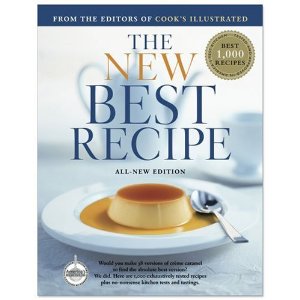

Also from the ATK/Cook's Illustrated folk is The New Best Recipe.   Whereas the ATK Family Cookbook presents everything in a very straight-forward, no-frills manner, The New Best Recipe is intended for cooking geeks.   Written in the technical Cook's Illustrated format, it features in-depth discussion of recipe testing and lengthly sections about various cooking techniques.  It also features a somewhat fancier and more esoteric bunch of recipes, over 1000 of them.  If you are just looking for stratightforward recipes, you would be better off with the ATK Family Cookbook, but if you're interested in comparisons of how different techniques interact with different cuts of meat, or find food science fascinating, this is one you will want. 


I am also a big fan of the Good Housekeeping Cookbook 125th Anniversary Edition.  This is another basic cookbook which covers a lot of the same ground as the ATK Family Cookbook, but from a somewhat different perspective.  I often find it helpful to look at several recipes for the same dish when developing my own version, and the two I tend to rely upon the most are this one and the ATK Family Cookbook.   Looking at commonalities between different versions of the same recipe, and also paying attention to the small differences that can make a big difference in flavor or ease of cooking, has made me a better cook.  Considered exclusively on its own merits, the Good Housekeeping Cookbook is a great deal, featuring 1275 solid, well-tested recipes, many of which have withstood the test of time. 


My next favorite is the Complete Step-By-Step Cookbook.  It is available in different editions by two different publishers, but as far as I can tell the contents are functionally identical, even down to identical illustrations.  For what it's worth, I have the Salamander edition, but again, I think the Thunder Bay Press edition is identical.  The promotional blurb about this book including everything the home cook could possibly hope for is a bit hyperbolic, at least in regard to this particular home cook, but I've been pleased by every one of the 800-odd recipes in this book that I've gotten around to making (probably about 50), and it has given me a lot of good ideas for my own recipes and for use in customizing standard recipes.   It features concise instructions and beautiful illustrations, and I can't imagine an amateur or home cook not finding some good stuff here.  This book has been around for awhile, and it is readily available for cheap at Amazon.


I've mentioned the next favorite before, but it's worth mentioning again, because Camellia Panjabi's 50 Great Curries of India truly is a great book.  This has become my go-to book for Indian cooking.   It features a great opening discussion of Indian culinary traditions and philosophy, and in terms of recipes, I've not yet found a book that features a better range of dishes drawn from the various Indian regional cuisines.  Plus, in addition to the "50 great curries" advertised in the title, this one features lots of recipes for Indian breads, sauces, vegetable and rice sides and so forth, putting the total number of recipes closer to 100.

October 19, 2010

Not Quite 30 Minutes, But Very, Very Good


The main course for Monday's dinner was a recipe from America's Test Kitchen 30 Minute Suppers, Pasta With Butternut Squash, Spinach and Prosciutto.  We also had some cherry tomatoes, and for dessert we had vanilla ice cream topped with some of the peaches Juli canned awhile back.  It was all excellent, and the pasta recipe is a real winner. 

America's Test Kitchen 30 Minute Suppers (Cooks Illustrated (96 tear-out recipe cards), Winter 2010)

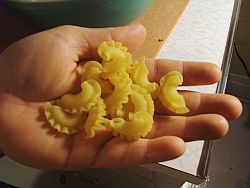
We made the main dish with an unusual, fancy pasta: creste di gallo, which translates to cock's comb.  Unsurprisingly, the individual pieces of pasta do indeed resemble the crest on a rooster's head.


Cubed butternut squash was sauteed in butter, white wine and chicken stock and combined with spinach, shaved prosciutto fried bacon-crisp and the pasta.  The dish didn't feature much in the way of seasoning - a couple tablespoons of fresh thyme, some salt used in preparing the pasta, and a bit of salt and pepper when serving - but with the blend of rich flavors, it didn't need much in the way of seasoning to be great.  The recipe as written gave us two very generous portions, plus enough left over for three lunches or dinners.

America's Test Kitchen 30 Minute Suppers, which was released last winter, is no longer available in stores, and Amazon.com is currently out of stock, but it is available through the Cook's Illustrated website.   It has a cover price of $7.95, or you can currently get it free as a special offer if you subscribe to Cook's Country magazine.  However you manage it, it is well worth your time to track down a copy.  The book is soft covered, magazine format, and inside the covers are 96 recipes, each printed as an individual recipe card.  There is a pretty diverse selection of recipes, including meat, poultry, seafood and vegetarian dishes and a section of main-dish salads.  The recipes represent a wide variety of cuisines.  Some examples include Thai Curry Chicken with Sweet Potatoes and Green Beans, Pork Schnitzel with Red Cabbage Slaw, Black Bean and Chorizo Enfrijoladas, Italian Pasta and Bean Soup, Quick Beef Provencal and Roasted BBQ Short Ribs. 

A lot of the recipes in this book look great, and I expect I'll eventually end up making a good chunk of them over time.   I think I got to page 5 before I encountered a recipe that didn't sound good to me (it features mayonnaise, and I can't stand mayo), which would have been 20 recipes in.  So, 19 out of 20 recipes looking like winners... that's one heck of a ratio!   Besides that, who can say no to a collection of tasty recipes that one can prepare in 30 minutes?   Not me, for sure.  That said, the "30 minutes" thing does bring up my one beef with  America's Test Kitchen 30 Minute Suppers.  As written, a very efficient and experienced cook probably can prepare all of these recipes in 30 minutes or less, and even a talented amateur like myself can probably manage most of them close to that time.  The "as written" part is the trick, though.


As written, many of the recipes in this book call for ingredients that are already prepared, but which you cannot easily purchase pre-prepared.  Or at least I can't, anyhow.  Maybe some of the America's Test Kitchen cooks lives in places where supermarkets sell things like heads of bok choy already stemmed and chopped up, but I sure don't, and I'm guessing that's the case for most of the book's potential audience.  Heck, I have a tough enough time finding fresh lamb during most of the year.  As another example, the recipe I prepared on Monday night calls for two butternut squash halves, peeled and seeded and cut into 1/2 inch pieces.  Once again, I don't recall ever seeing cubed - or even pre-split and seeded - butternut squash in stores, and getting a butternut in that condition takes a fair bit of time.  These are only two examples, but there are many more. 

Sometimes the recipes call for spices already prepared - Pasta with Butternut Squash, Spinach and Prosciutto also calls for minced fresh thyme, for example - and a good many call for ingredients that have been peeled, sliced, minced, pressed, trimmed or otherwise prepared.   Even canned ingredients often call for being drained and rinsed, and while that seems a minor quibble, opening cans, draining and rinsing does take time, and that time adds up.   So, yes, if one starts as specified in the recipe, with all the preparation already done, one can probably get the dish ready in 30 minutes or less (or a bit more, for less-expert cooks)... but the preparation, and the organization required to cook efficiently, are also part of the cooking process, and to not account for them in the advertised time is a bit of a cheat.

That quibble aside, I really do recommend America's Test Kitchen 30 Minute Suppers.  Just remember to give yourself a bit more than 30 minutes to get many of the recipes ready.  If you are reasonably organized, the majority of the recipes in the book can probably go from fridge and pantry to table in less than one hour, and that's still pretty good.

October 12, 2010

Good Things Sometimes Come in Plain Packages

I own a fair number of cookbooks, but one of the ones I turn to most often is one that I almost didn't notice at all. It's a good cookbook that deserves more attention, but neither the cover nor the title really jumps forward to grab the reader's attention.

The cookbook in question is Pamela Clark's New Curries, pictured below. The title, while getting points for accuracy,  isn't exactly dynamic. Heck, the title font doesn't even include capital letters. The front and back covers are adequate enough, but not so interesting as to really draw the eye; the front cover depicts a colorful Vietnamese beef and green bean curry in a plain white bowl, while the back cover depicts a Thai shrimp curry. Both look tasty enough, but neither picture is anything special, certainly nothing that rises above the food photography standard to cookbook illustrations.

New Curries by Pamela Clark
paperback, Fall River Press (2010 edition)


There's not even much in the way of cover copy... no blurbs or description, nothing at all but the title and a listing of nations, the cuisines of which are represented in the book: India, Sri Lanka, Thailand, Malaysia, Indonesia and Vietnam. The author's name doesn't even appear on the cover (though it is listed on the book's spine).

I first encountered this book on a remainder table at one of the big book stores.  The table was covered with stacks of different books, and this was one of them.  The first time I looked at the table, I don't think New Curries actually registered with me, even though I love curries.  Another book - an Asian cookbook of some sort, I think - had caught my eye, and I spent some time flipping through that before deciding it wasn't different enough from ones I already owned to justify the purchase.  While replacing the book I'd decided not to buy, I finally noticed New Curries.  I'm sure glad I did. 
In writing New Curries, the author's stated mission was to introduce people who were perhaps familiar only with Indian and Thai curries - and even then only with the standard restaurant dishes - to a wider range of curries reflecting a wider range of cuisines and cooking traditions.   In addition to the nations listed on the cover, this book also features curries from Kenya, Trinidad and Nepal.   The various recipes feature a wide range of ingredients, and produce dishes of widely different flavor, aroma, texture and presentation.  As such, I think Ms. Clark succeeded admirably in her goal.

As cookbooks go, New Curries is pretty straightforward.  After a brief, general discussion of curries, mostly consisting of different ingredients used in curries, the author goes right into the recipes, which are divided into sections for seafood, chicken, beef, lamb and pork and vegetarian curries, plus a section on how to make various standard curry mixes and pastes and some of the sorts of rice, chutneys and so forth that often accompany curry dishes.  The book closes out with a brief but fairly good glossary.  Each of the curries is accompanied by a full-page illustration.  The recipes are written out very clearly.  Each is accompanied by information regarding nutrition, prep time and so forth, and most also feature a brief side-bar providing information on the culture represented by the dish, how it's usually served or how else to use some of the ingredients. 

You might have noticed in the photo above that my copy of this book is tabbed in several places.  Each of these tabs indicates a dish I plan to try.  New Curries isn't a very long book - 128 pages - so the number of tabs should give you some idea how many great recipes are in this book.

I've already made several of the recipes in New Curries.  I've enjoyed each of them so far, though some more than others.  Stand-outs so far have been the Kenyan chicken curry, the butternut and green bean curry and the Malaysian lamb curry.   I've not yet tried any recipes from this book that I'd suggest readers avoid, though there are a few that I'll probably customize somewhat next time I cook them.  Most, though, are fine as-is.

The only negative comment I have about New Curries is that the book itself is very poorly bound.  The cover is almost completely detached already, and a few pages are getting loose.  I'll probably have to hole-punch this book and transfer it to a small ring binder in the near future.

If you like curries and would like to experiment with the wide range of curries produced by different cultures, I recommend you give New Curries a try.  It may not look that impressive on first glance, but if you actually make some of the recipes, you'll find the old saying really is true:  You can't judge a book by its cover.

October 04, 2010

Great Curries

Last Saturday I made two Indian dishes.  Though neither was my own recipe, I'd never made either before. One came from a standard Indian cooking reference, while the other came from from the newest issue of one of the cooking magazines I find most reliable.

50 Great Curries of India


The standard reference in question is 50 Great Curries of India by Camellia Panjabi.  First published in 1994, this work has been through numerous printings and editions (though the differences from edition to edition are apparently minor) to become one of the standards of Indian cooking.  Considering both the book's contents and its author, it's easy to see why.  A native of Mumbai, Ms. Panjabi worked for one of India's most prominent hotel chains, one known for culinary innovation, before going to the UK and, individually and along with family members, launching some of Britain's most successful Indian restaurants and chains.  This lady knows food, and particularly Indian food, and the book's content shows this.

The opening section covers about the ingredients, techniques, traditions and philosophy behind Indian cooking.  There are sections dealing with the regional differences in Indian cooking, and how the lack of standardized versions of famous dishes is a result of Indian cooking being very much home-based.   I found the discussion of the philosophy of Indian cuisine quite interesting.  While I'm not an adherent of the Ayurvedic philosophies that underlie traditional Indian cooking, I found this section interesting due to the discussion of how this tradition results in the balance of different flavors that characterizes Indian cuisine.  I also found the ingredients section informative, as it went into a bit more detail describing typical (and some less-than-typical) ingredients common to Indian cooking and their uses and purpose within the recipes.

The bulk of the book is a collection of recipes: the promised 50 curries, plus a selection of Indian breads, side dishes, chutneys and so forth to accompany them.  There are versions of standard fare familiar to Western fans of Indian cooking (Lamb Vindaloo, Butter Chicken, Malabar Shrimp Curry) plus a variety of dishes less recognized in the West.  They range from fairly simple to very complex; some of the dishes are associated with emperors while others are very standard Indian family fare.  Each of the curries is accompanied by a beautiful, appetite-inspiring, full-page photograph of the dish. 

So far, this is a book I've learned from more than I've cooked from, as the recipe I made on Saturday was the first I've actually cooked from the book.  The recipes are a bit more complicated than in some other books, such as Manju Malhi's Easy Indian Cookbook: The Step-by-Step Guide to Deliciously Easy Indian Food at Home (previously reviewed here: http://jeffreyandjulicook.blogspot.com/2010/09/this-book-got-me-started.html ), and probably not the best choice for someone just starting with Indian cooking.  That said, the informational parts of this book are so strong that I think it's a good thing for someone starting cooking Indian to read.  Combine the information in this one with the recipes in Malhi's book and you've got a great start to Indian cuisine, and once one has gotten the hang of Malhi's recipes, the recipes in 50 Great Curries offer lots of slightly more advanced options.  There are a lot of recipes in this book I'm planning to try out.  The White Chicken Korma, Chicken Pistachio Korma and Shrimps in Sweet and Hot Curry look particularly mouthwatering. 


The recipe I chose for my first foray into 50 Great Curries of India was Lamb Korma Pilaf... essentially, a casserole consisting of a lamb curry sandwiched between two layers of rice, the top saffron-infused, the bottom having absorbed the gravy from the lamb curry.  It was a flavorful but fairly mellow dish, which went well with my second choice:  South Indian-Style Vegetable Curry, from the newest issue of Fine Cooking.  This was a spicy, flavorful curry with chick peas, cauliflower, carrots and sweet potatoes.  It's not the world's most unique dish - there's a very similar dish in Malhi's book - but it sure is tasty, and it went perfectly with the Lamb Korma Pilaf. 


The picture below shows Saturday night's supper, consisting of the two dishes above, plus some naan and watermelon.


September 24, 2010

This Book Got Me Started

Started with Indian cooking, that is.   All the recipes I made during my first three-day adventure in Indian cooking came from the same cookbook.  Following is a review of that book.

Easy Indian Cookbook: The Step-by-Step Guide to Deliciously Easy Indian Food at Home by Manju Malhi
216 pages, spiral bound   

One of the blurbs on the back cover of the book reads "Genuine Indian food made easy so you can experience and enjoy the real thing in your own home."  I'd say that description is a pretty good one.  The recipes are clearly written and pretty straight-forward in terms of technique, and none of the required ingredients are difficult to find if one has access to a good Indian or Asian grocery, or simply a wide range of spices via Penzey's or some similar source.

The book begins with a basic discussion of typically Indian ingredients and techniques, then moves on to some simple, basic recipes for making Indian breads, chutneys, spice mixes and rice.   Overall, this section of the book is pretty good, but it isn't without problems.  As I mentioned yesterday, I found the Naan recipe to be a disappointment, but the rest of these basic recipes have worked out just fine.  Also, I think the discussion of Indian ingredients and cooking techniques could have benefited a lot from some illustrations. 

After getting the basic stuff out of the way, the author moves on to the real core of the book:  A wide selection of recipes, divided up between snacks and appetizers, vegetarian, meat and poultry, seafood, side dishes and desserts.  the book ends with a discussion of what dishes one might wish to serve together for specific sorts of situations (box lunch, romantic dinner for two, cocktail party, family meal, etc.). 

I should note that I own a different printing of this book than the one pictured above.  Apparently there are several printings of the book on the market, some (like mine) softcover, others spiral-bound.   The one pictured above includes a CD of traditional Indian music.  I've not heard the music, so I can't comment on it, but I doubt it takes anything away from the quality of the recipes (which is probably what most potential buyers really care about), and I suppose it might add some nice atmosphere to one's dining experience.   The printing I bought doesn't appear to be available anywhere online (I got it the remainder/bargain section of a bookstore), but I'm pretty certain the different versions of the book are identical in terms of content (same page count, same format, etc.).  

To date, I have prepared approximately 1/4 of the recipes in this book.  There are a lot of recipes for dishes that will be familiar to anyone with even a modest knowledge of Indian cuisine.  These include standard Indian restaurant fare like Vegetable Samosas, Rogan Josh, Chicken Korma, Mattar Paneer and some versions of Biryani (meat or vegetables cooked along with rice), as well as some less typical choices, such as Tandoori-Style Trout.  Based on my experience, the recipes are of variable quality, but the vast majority of the ones I've prepared have fallen in the very-good-to-excellent range (4 to 5 stars, by the ranking Juli and I use around the house).  Some of our favorites have included an Indian Tomato Soup, Channa Masala (chickpea curry), the Bhuna Dal and Tandoori Chicken Bites (both pictured above), Shrimp with Garlic and Chili, and Pork Vindaloo.  We've revisited some of those recipes already, and there are still a lot of recipes in the book I look forward to making.

Although we haven't found this book to fall within the "every recipe is a winner" category, the hit/miss ratio is still quite good.  I've used this book a lot, and I consider it a very good choice for someone new to Indian cooking.

September 23, 2010

Excellent Grilling Reference

In my previous cookbook review, I noted that we weren't getting paid to do the reviews, but were instead doing them because we wanted to tell people about references and equipment we've found particularly useful. Well, as you will see in today's review, we are now participating in the Amazon Associates program, but we want to assure you, that original statement is still true. Yes, we will make a bit of money if some of our readers follow the links to Amazon and buy something we've reviewed, but that's not the reason we're doing the reviews. We're doing them because we want to, and we choose what to review based on our experiences and opinions, without regard to what might potentially earn us more money.

So, with that out of the way, on to my next review.

I love grilling.  There's something primal about cooking over hot coals (no gas grilling for me, thanks), and about the marks left behind by searing food on a hot grill.  Then there's the wonderful aroma of smoke (especially if one mixes some wood in with the coals).  And then there's the unique flavor of grilled foods.  Let's face it, some foods just aren't as good if they aren't grilled.  Steaks, for example.  Or burgers.  Plus, the grill is an amazingly versatile way to cook.   With the right tools, there are relatively few things one can't prepare on the grill.

Much as I love grilling, though, I don't claim to be any sort of expert.  At best, I'm a talented amateur, though dedicated to continued improvement.   So, I'm always looking for new tips and tricks and techniques - and recipes, of course.   Weber's Big Book of Grilling is one of the best sources I've found for all of the above.

Weber's Big Book of Grilling

Weber's Big Book of Grilling
by Jamie Purviance, Sandra S. McRae and Tim Turner
May 2001, Chronicle Books
416 pages, softcover

Really, Weber's Big Book of Grilling has it all.  It starts with a discussion of grilling basics:  techniques, safety considerations and so forth - then moves on to a discussion of marinades, rubs and sauces:   how to make them, their proper use, the effects one can achieve with each and so forth.  The rest of the book mostly consists of a dizzying variety of recipes for everything from appetizers to desserts.  There are also sidebars, or occasionally pages, dishing out the occasional tip, bit of useful information or funny anecdote.  The recipes cover a range of different regional traditions and include dishes from a variety of cuisines.  From Memphis rubs and Kansas City sauces to Caribbean jerk chicken and Thai shrimp skewers, whatever sorts of grilling you favor, you'll probably find a bit of that in this book.  Best of all, Weber's Big Book of Grilling is very readable.  The authors dish out their advice with heaping portions of humor and a conversational tone not unlike what you might overhear when a group of friends are swapping tips while grilling some brats in the backyard and tossing back a beer or six.

I've gotten a lot of use out of this book, and expect I will continue to find it useful for years to come.  There may be some books that go into deeper detail about the art of grilling (though none come to mind), but I don't think I've run into any that are so broadly useful, or nearly so entertaining.  I've gotten particularly good mileage out of the sections on grilling vegetables and ribs. Whatever your grilling tastes, unless you're already such a master griller that you should be writing your own books, you'll probably find something in this book that will be helpful.

September 21, 2010

"Best-Ever Recipes" Lives Up to Its Title

Every now and then, along with all the recipes and pictures and reports on the cooking we've been doing, Juli and I are going to be presenting some reviews of things we have found helpful in our cooking adventures.  This is particularly likely on Tuesdays and Wednesdays, when we normally get home way too late to do any cooking.  We might review cooking equipment, or good resources for hard-to-find ingredients, or vendors in our area, or online recipe and cooking-advice sites or - as is the case today - cookbooks.  I should note that we're not being paid to write these reviews.  We write them because we really like the items or resources in question, and want to pass along the good word to others who might be interested. 

So, with that in mind... here's our first review.

Best-Ever Recipes Special Collector's Edition
America's Test Kitchen Special Issue
96 pages, softcover
$9.95


If you do an Amazon search, you will find there are lots of cookbooks that include the words "Best-Ever Recipes," or some variation of that claim, within their titles.  I've looked at some of those books and have generally been unimpressed, but Best-Ever Recipes actually lives up to its title. 

Best-Ever Recipes is a collection of recipes compiled from the America's Test Kitchen line of products (Cook's Illustrated and Cook's Country magazines, and the ATK cookbooks), representing what the ATK editors consider their very best recipes, and the ideal recipes for those particular dishes.  Having used several of the recipes from this book, I'd have to say that they succeeded in bringing together a true "best-ever" collection.  This book is packed with great recipes. 

The recipes in this book run the gamut.  Main dishes, sides, breakfasts, desserts, meat, pastas, sauces, vegetarian, Indian, Chinese, Latino... they're here, and lots more besides.  Most of the recipes are standard fare - things like fried chicken, pasta primavera, beer-can chicken, beef enchiladas, chicken tikka masala, potato salad, oatmeal cookies, and even nachos - but while the dishes are mostly pretty familiar, the results you'll get from these recipes are anything but ordinary.  I've tried out several of the recipes in this collection, and every single one has been not only a winner, but among the best - and sometimes, yes, the best-ever - example of those dishes we've ever had.  Although Best-Ever Recipes includes a few recipes I'm not likely to ever make, simply due to my personal tastes, I expect I'll eventually make the vast majority of the recipes in this book.  As to the ones I've already made... well, as much as I like trying new and different recipes (and believe me, I don't lack for recipes I haven't tried out yet), I expect I'll be making all of them again sooner rather than later.   In fact, currently I'm considering making one this weekend.

Anyhow, unless you're someone who already has a thorough collection of the America's Test Kitchen cookbooks and magazines (in which case you probably have most or all of these recipes), I really can't recommend this one enough.   You might still be able to find it in stores, but if not, you can order it at the link below.

http://www.cooksillustrated.com/bookstore/detail.asp?PID=474